A ULA Vulcan rocket failed 10 minutes after launch on Nov. 15, losing 40 Amazon Leo satellites. What is known, what is not, and what it means for Amazon.
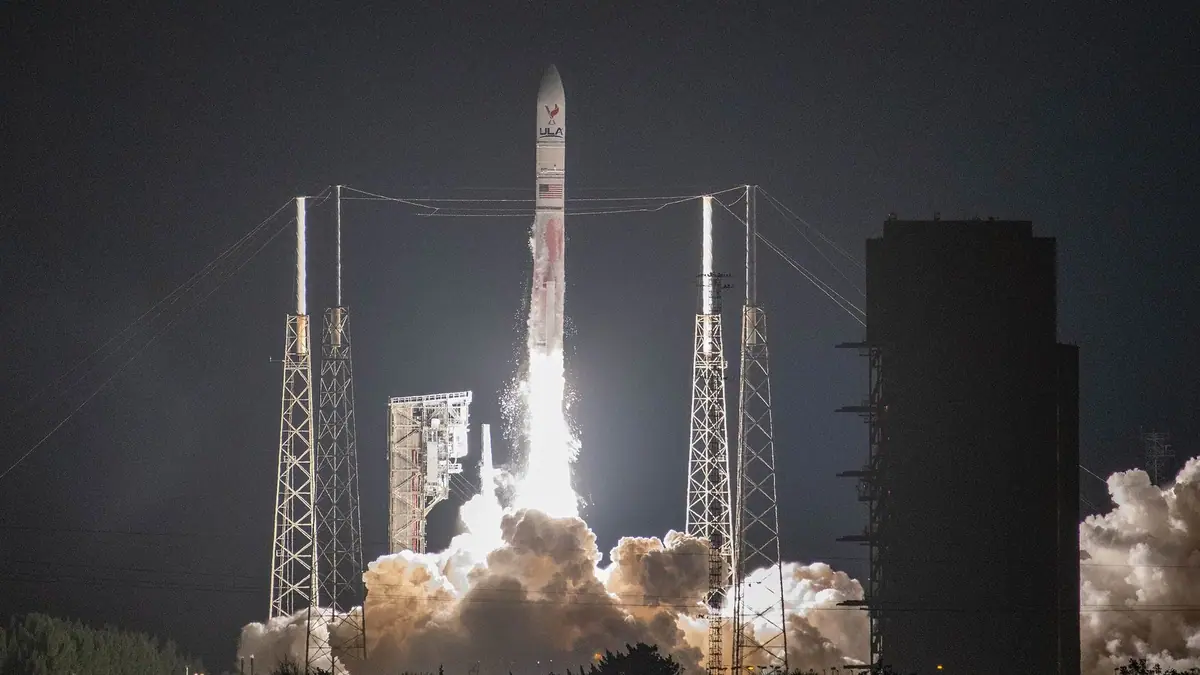
United Launch Alliance's Vulcan rocket failed on Sunday, Nov. 15, and 40 Amazon Leo satellites were lost with it, according to Ars Technica and Engadget. It was the first total mission failure in ULA's history since the company formed in 2006. The rocket lifted off from Cape Canaveral, Florida, at 12:40 p.m. ET, and ULA said it "suffered an anomaly 10 minutes into the flight and failed to deliver the Amazon mission to orbit."
What happened to the Vulcan rocket?
The six solid rocket boosters appeared to work normally for the first two minutes, Ars reports. Engadget adds that a hold at T-minus 20 seconds was cleared before the launch window closed, after a fueling problem had already scrubbed an attempt on Friday.
The trouble came after that. Ars says the two Blue Origin-built BE-4 engines on the first stage were meant to shut down just before the five-minute mark but kept burning for at least 30 more seconds. A ULA animation driven by live telemetry then showed the rocket start to spin. Ars's sources say the problem was in the booster stage, not the Centaur V upper stage or the solid boosters. Engadget, citing ULA's own website, says the anomaly appeared to come during the Centaur burn. The two accounts differ, and ULA said it did not yet have data to explain what occurred, so the cause is unconfirmed.
ULA ended its live broadcast without discussing the problem, then posted that the mission had failed. In its statement it said: "Today, we did not meet that standard." The company promised a corrective action and a return to flight "as quickly as possible."
Why does this matter for Amazon Leo?
This was the first of 38 Vulcan launches Amazon has booked, per Ars, so 37 remain. Ars puts the Amazon Leo constellation at 396 satellites now, against a planned 3,292 first-generation spacecraft. Engadget says about 390 are in service. The gap between those numbers is small, but the two outlets do not match, and Amazon has not given us a figure here.
Engadget reports the Federal Communications Commission required Amazon Leo to have 1,600 satellites up by July 31, 2026, a target the network missed by a wide margin. Ars says Amazon told it in October that it had enough satellites to start initial commercial internet service by year's end, though more launches are needed for full capacity. Amazon has also built its 1,000th satellite, per Ars, so more than half the network sits in storage waiting for rides.
Amazon's statement said there is risk with any launch, "especially true for inaugural missions like LV-01," and that it believes ULA will learn from this mission.
What does it mean for U.S. launch plans?
Ars says Vulcan is on contract to fly roughly half of the U.S. military's national security space missions in the next few years, and calls the failure a potential setback for NASA's Artemis moon program too. Engadget notes that ULA's older Atlas V has been famously dependable, which makes this a sharp contrast.
The other big heavy rocket Amazon relies on is not available either. Ars reports a Blue Origin New Glenn exploded during a ground test in Florida in May, and investigators traced it to a faulty valve on a BE-4 engine. If the BE-4 turns out to be involved in Sunday's failure, Ars says it could delay New Glenn's return to flight, which Blue Origin had pointed to for early next year. We stress that this is a conditional: nobody has said the BE-4 was at fault.
Amazon does have other options. It has 24 launches booked with Arianespace, three flown so far, and the fourth is set for later this month on an Ariane 6 from French Guiana, according to Ars. It also has 10 more missions booked on SpaceX's Falcon 9.
What is confirmed and what is not?
- Confirmed by ULA: an anomaly 10 minutes into flight; the Amazon mission did not reach orbit; an investigation is under way.
- Reported: 40 satellites lost; BE-4 burn ran long; booster stage involved (Ars's sources).
- Unknown: the root cause, how long Vulcan will be grounded, and Amazon's revised launch schedule.
Our take
This is analysis, not reporting. For ordinary U.S. readers, the nearest effect is on when Amazon's satellite internet becomes a real alternative to Starlink. A smaller network can still serve limited early customers, as Ars's October account suggests, but the schedule just got harder. Amazon has leaned on SpaceX rockets before to catch up, and with Vulcan likely grounded, that dependence probably grows. How long depends entirely on what the investigators find, and ULA's earlier solid-booster problems, which Ars says led to monthslong reviews, are a reminder that these investigations rarely finish quickly.
Nothing here needs action from a consumer. If you are waiting on Amazon Leo service, watch for official updates from Amazon on a start date, because none has been given in the reports we read.
Related reading
Picture credit: Photo: U.S. Space Force, Jan. 2024 Vulcan launch (public domain)