Voyager 1 crossed one light-day from Earth on Nov. 18, 2026, about 16.1 billion miles out. Here is what that means and what comes next.
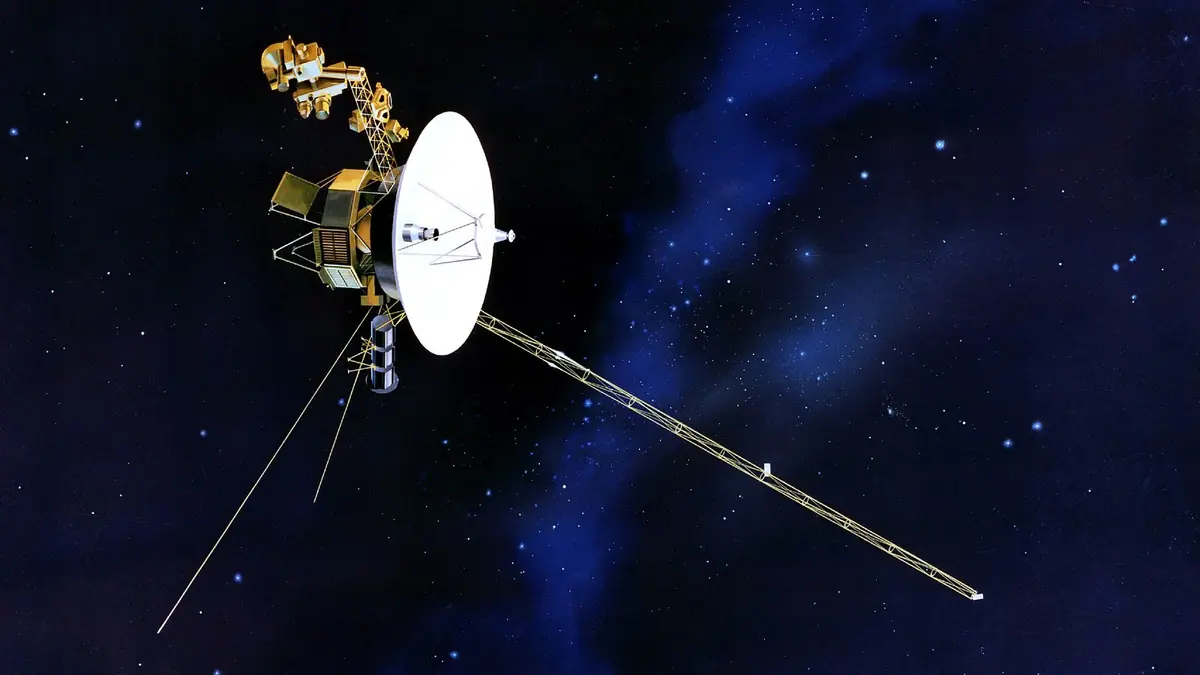
NASA's Voyager 1 probe passed a distance of one light-day from Earth on Wednesday, Nov. 18, 2026, at about 5:16 a.m. ET (10:16 UTC), according to reports from The Verge and Engadget. That puts it roughly 16.1 billion miles away, farther than any human-made object has ever been.
One light-day is exactly what it sounds like: how far light travels in 24 hours. Radio signals move at the same speed, so a command sent to the spacecraft now takes a full day to arrive.
How far is one light-day, and how long do Voyager 1 signals take?
One light-day is about 16.094 billion miles, the figure The Verge reported for Voyager 1's position at the milestone. A signal from Earth needs 24 hours to reach the probe, and the reply needs another 24 hours to come back, Engadget notes. So any back-and-forth with the spacecraft takes two days.
That has a odd side effect. NASA calculated the crossing time from the probe's known path, and Engadget reports the agency can't verify the exact moment until the spacecraft's own message arrives on Thursday. For now the 5:16 a.m. ET mark is a prediction that nobody has checked against the probe itself.
Engadget quotes Voyager mission manager Kareem Badaruddin on the moment: "It's never happened before, and it may never happen again."
Is Voyager 1 still working?
Yes, with limits. The Verge says the probe can still send back readings on plasma waves, magnetic fields and particles in space. Engadget adds that NASA has had to shut off some of its instruments over the years to stretch the plutonium power supply, which keeps shrinking.
Voyager 1 launched in 1977, 16 days after its twin, Voyager 2, and reached interstellar space (the region between star systems) in 2012. Engadget counts the trip at 49 years, two months and 11 days as of Nov. 18. Few spacecraft in history have been asked to run that long, and this one has already survived technical glitches that could have ended its mission.
Where is Voyager 1 headed next?
The probe is pointed toward Gliese 445, a star about 17 light-years away in the constellation Ursa Minor. It moves at nearly 38,000 miles per hour, The Verge says, and still won't get there anytime soon. Engadget reports it should pass within about 1.7 light-years of the star in roughly 40,000 years.
Voyager 2 is expected to reach its own one-light-day mark too, but not until 2035, per The Verge. It is on a different path and is farther behind.
What is the Golden Record story tied to this?
Ars Technica used the milestone to look at the Golden Record, the phonograph disc each Voyager carries as a message from humanity. Glen Swanson, a former chief historian at NASA's Johnson Space Center, told the outlet he dug up a forgotten second set of operating instructions for the discs and found duplicates made decades ago.
Swanson is writing a book with Jon Lomberg, the record's design director. Ars reports that Voyager's Golden Record: An Enduring Reflection is due from the University of Chicago Press in August 2027.
One detail from that piece stuck with us. The protective cover carries the instructions for playing the record, but the cover itself is exposed and will wear. As Swanson put it, the designers knew the outside would erode. The disc lasts, but the manual on its sleeve may not.
Our take
Our take: this is a milestone people can feel, which is rare for a distance record. Sixteen billion miles is hard to picture. A 24-hour delay is easy. Anyone who has waited a day for a reply to a text understands it.
For U.S. readers, there is nothing to buy or watch. It's a NASA story and the agency's own channels are the place to follow it. We would skip any social post claiming the probe is about to leave the galaxy or hit something. The sources we read say nothing like that.
What we don't know yet: whether the probe's own signal, due Thursday, matches NASA's predicted time, and how much longer the power supply can keep any instruments running. Neither outlet gives a date for that, and we won't guess one.
Related reading
Picture credit: Illustration: NASA/JPL, public domain, via Wikimedia Commons