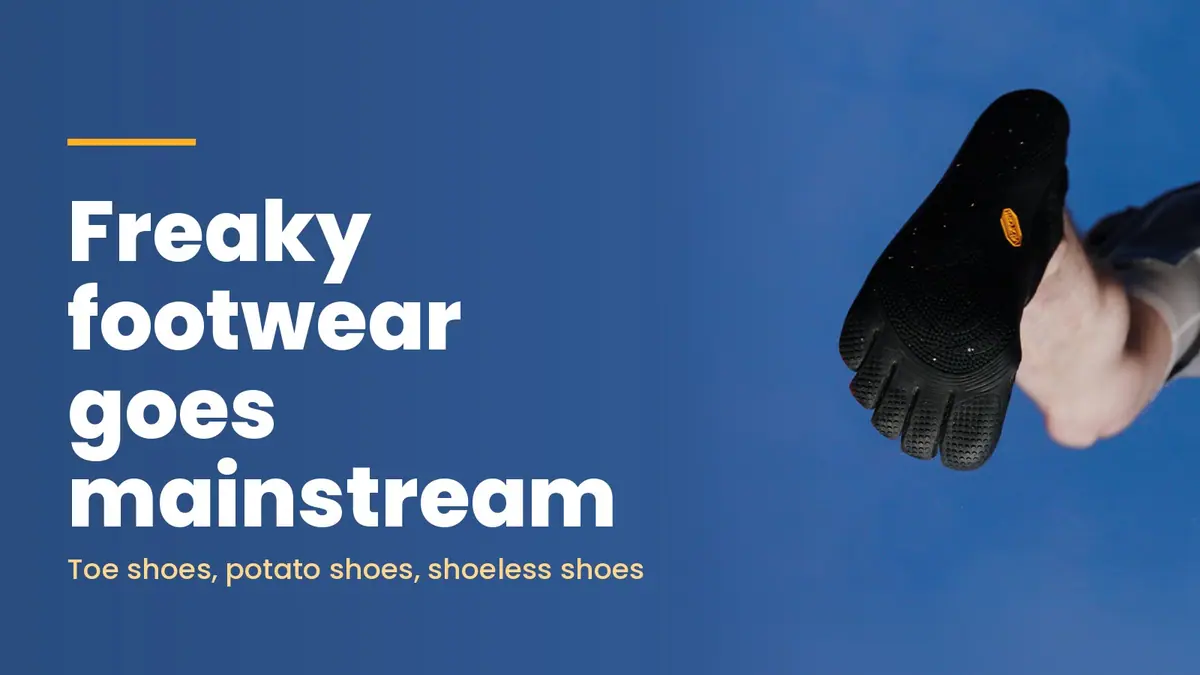
The Guardian says toe shoes, potato shoes and Tabi splits have left the catwalk, with Lyst reporting Tabi demand up fourfold since 2022.
A few years ago the shoes on a commuter train were mostly forgettable: a plain pump, a sporty trainer, a basic ballet flat. The Guardian says that has changed. Its fashion report on Sunday argues that deliberately strange footwear, once confined to the catwalk, is now turning up on high streets, in offices and at weddings.
What counts as freaky footwear
The paper points to Vibram's FiveFingers, the glove-like shoes with a pocket for each toe, and to split-toe Tabi styles. According to the fashion search platform Lyst, demand for Tabi-style shoes has risen fourfold since 2022, and FiveFingers are up 57% year on year. Designers are playing too: Simone Rocha has made supersized Crocs covered in pearls and gemstones, and Etro has joined Dior and Valentino in reworking Birkenstock's cork-footbed clogs.
The cheaper end is catching up. The Guardian says a £38 pair of French gardening clogs, the Gardana, built up long waiting lists this summer, while Celine sells a similar pair for £670. Marks & Spencer's £45 "potato" shoe, a bulbous soft suede style, has become one of its fastest-selling autumn options. High-street chains are selling "Frankenshoes" such as the sneakerina and the snoafer, which blend a trainer with a ballet flat or a loafer.
Why people are wearing them
The report quotes several explanations. Dal Chodha, a writer and lecturer at Central Saint Martins, calls the trend thrilling and says it pushes people to embrace something that feels ugly or absurd. Valerie Steele, chief curator of the Museum at the Fashion Institute of Technology, notes that strange shoes have a long history, from long-toed medieval poulaines to towering chopines, and says feet are far from your face, so you can experiment without looking ugly.
It also leans on the "wrong shoe theory", coined by stylist Allison Bornstein in 2023: wear a slightly off shoe, such as a kitten heel with tracksuit bottoms, and the whole look reads as chosen. Some interviewees see politics in it, as a reaction to a more polished, conservative look. Others link it to a "soft life" mood among young people who are anxious about work and housing and would rather pad around than stomp.
Not everyone is thrilled. Lars Byrresen Petersen, who runs the shoe meme account @LarsLaLa and says he has worn Tabi shoes every day for ten years, tells the paper that people who do not know the style's history are wearing it for shock value.
Where it goes next
Lyst's Barbara Janeczek says fashion is good at normalising the previously unwearable, and that each wave has to find something weirder. The Guardian's own pick for the extreme end is Chanel's "shoeless shoe", shown in Biarritz in April and later worn to a London film premiere by Margaret Qualley. It is just a heel cap with the double-C logo and nothing else.
Our take
This is analysis, not reporting. The trend sounds more practical than it looks. Toe shoes and potato shoes are flat, roomy and easy to walk in, and that probably matters more to their popularity than any theory about politics or irony. We would also treat the Lyst figures as a snapshot from one platform rather than a measure of everyone's wardrobes. As for the shoeless shoe, it is hard to picture it outside a catwalk or a red carpet.
Picture credit: Vibram (photo). Design: Savvy VibeZ