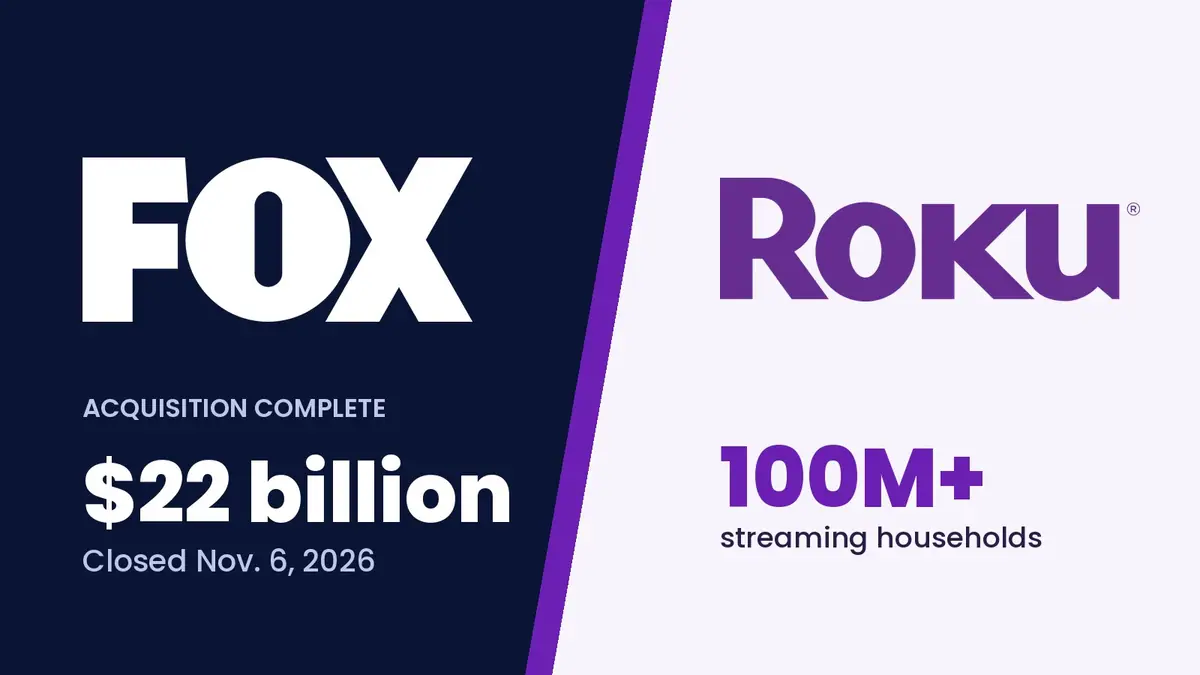
Fox Corp. closed its $22 billion Roku purchase on Nov. 6, far ahead of schedule. Here is what changes, what Fox promised and what is still unknown.
Fox Corp. said on Friday, Nov. 6, that it has closed its $22 billion purchase of Roku, according to Fox's own announcement and Variety. The deal was expected to finish in 2027, so the close comes well ahead of schedule. If you own a Roku player or a TV with Roku built in, nothing changes on your screen today, and Fox says it plans to keep the platform open to rival apps.
What did Fox's Roku deal close on Nov. 6 actually change?
Ownership, mostly. Roku shares stop trading on Nasdaq as of Nov. 6, and Roku becomes part of a new Fox division called FOX Digital Platforms. Fox says that division also includes Tubi, Fox One, Red Seat Ventures and other digital businesses.
Roku founder Anthony Wood joins the Fox board and becomes co-chair of the new division. The other co-chair is Paul Cheesbrough, who is also its CEO. Fox says Roku's platform reaches more than 100 million households, and it now describes itself as one of the leading streaming businesses in the U.S., counting Roku, Tubi and Fox One together.
How much did Roku shareholders get?
Under the merger agreement, each Roku share converts into $95.30 in cash plus 0.9799 shares of Fox Class A stock. When the deal was announced in June, Variety reported the price as $160 per share, made up of roughly $14.2 billion in cash with the rest in Fox stock. Because part of the payment is stock, the exact value per share moves with Fox's share price, which is why you will see slightly different dollar figures in different reports.
After the close, Fox shareholders own about 74% of the combined company's shares and former Roku shareholders own about 26%, according to Fox.
Will Roku stay open to other streaming services?
That is the question most viewers care about, and Fox's answer is yes. Its release says Roku will continue as "a leading open ecosystem for the broader streaming industry," and Fox CEO Lachlan Murdoch said the top priority is reinforcing the openness and choice that define the platform. Variety reads that as a pledge not to give Fox News or the Fox One package special positioning on Roku.
Wood said much the same, adding that Roku's teams will keep building as they always have, with Fox's resources behind them.
What is confirmed and what is not?
Confirmed by Fox: the deal is closed, Roku is delisted from Nasdaq, Wood and Cheesbrough lead the new division, and Fox expects about $400 million in annual cost savings within two years of closing. Fox also expects the deal to add to free cash flow per share by the second full year.
Not stated: where those savings will come from. Variety notes that a figure like $400 million suggests layoffs are coming, but Fox has not said how many jobs are affected or when. There is also no word on changes to Roku's home screen, its ad products or its pricing for device makers.
Our take
This is a distribution deal as much as a media deal. Fox owns live sports, news and a free streaming service in Tubi, and it now owns the screen a large share of U.S. households use to reach them. That is a real advantage, and rivals will notice it.
The open-platform promise is easy to make on day one. What we would watch is the home screen over the next year: which channels get the prominent rows, how Tubi and Fox One are presented, and whether Roku's relationships with Netflix, Disney and other partners stay as comfortable as they are today. If you want a simple precaution, nothing needs to be done now. If the layout or ad load starts to feel different, that is the signal.
Related reading
Picture credit: FOX and Roku logos: Fox Corp., Roku. Design: Savvy VibeZ