Engadget gives the $539 HOVERAir Versa pocket camera that flies an 8 out of 10. Here are the pros, the prices and the U.S. availability question.
As of Tuesday, Nov. 10, 2026, Engadget has published its review of the HOVERAir Versa, a $539 pocket gimbal camera that also turns into a small flying camera. Reviewer James Trew gave it 8 out of 10. That score belongs to Engadget, not to Savvy VibeZ, and we have not tested the Versa ourselves. The review also flags an awkward problem for U.S. shoppers: Engadget says the Versa's U.S. availability is unclear.
Here is what the Versa is, what Engadget liked and disliked, how the prices stack up and what the U.S. question means for buyers.
What is the HOVERAir Versa?
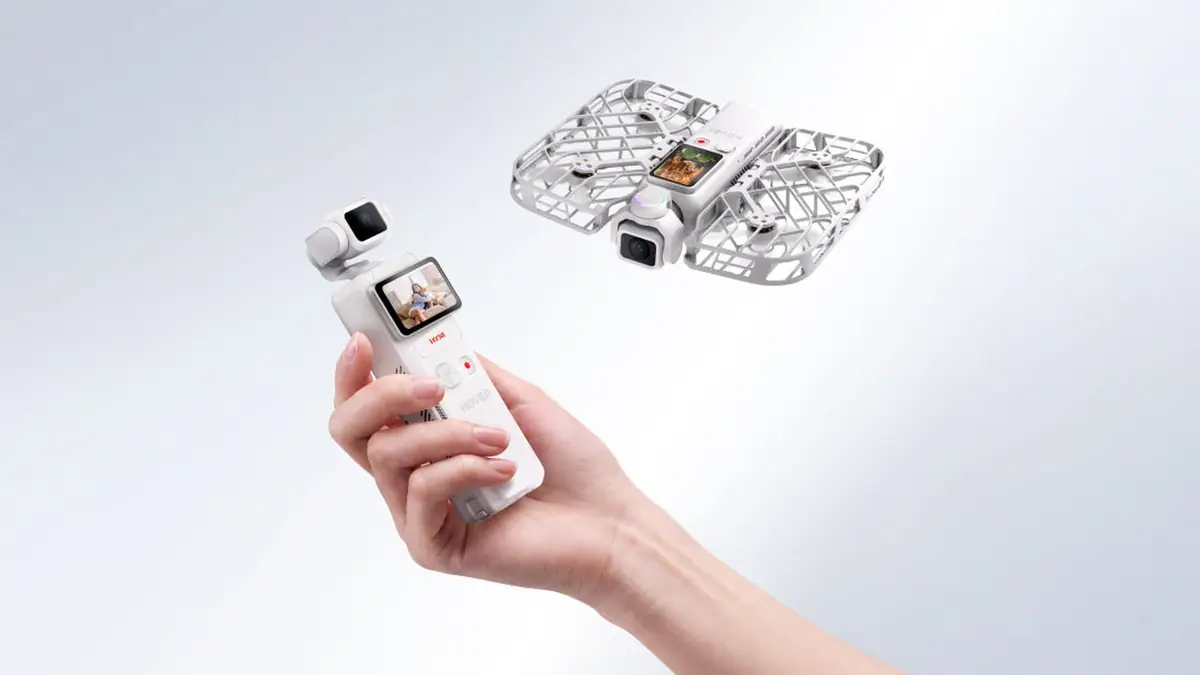
Engadget describes it as a handheld gimbal camera, similar to DJI's Osmo Pocket 4 or the Insta360 Luna Pro, that becomes a mini drone when you snap on a flight kit. HOVERAir's own product page calls it a 2-in-1 pocket gimbal camera that transforms into an AI flying camera.
The specs Engadget lists: 4K video at up to 60 frames per second, a 1/1.3-inch sensor, 2x in-sensor zoom, a 10-bit HDR mode and a 3-axis gimbal. Photos are limited to 12 megapixels. There is 55GB of built-in storage, expandable by SD card, though cards under 64GB are not supported. HOVERAir claims 17.5 stops of dynamic range, a figure Engadget repeats as the company's claim. H-Log support is promised in a future update.
What did Engadget like and dislike?
The pros, per Engadget: a decent gimbal camera, the drone conversion and a solid accessory selection. The cons: it lacks advanced camera modes, and the drone has no obstacle avoidance. In drone mode, the Versa uses downward sensors to hold position and supports palm takeoff and landing, but it will not see obstacles behind or around it.
Trew found the footage sharp and the gimbal smooth, though color felt less natural than DJI and Insta360 rivals. Outdoors, he said, the sky was heavily saturated, and indoors white walls took on a slightly beige tint. The screen is a cramped 1.64 inches, against 2 inches on the Luna Pro.
On the fun side, the drone mode offers preset flight paths such as hover, follow and orbit. There is also a "3D worlds" feature that flies around you and builds a three-dimensional model you can export. Launch accessories include an ND filter kit, a magnetic tripod and a small handheld controller.
How much does the HOVERAir Versa cost, and can you buy it in the U.S.?
The camera is $539 in Engadget's review. To fly it, you need the flight kit, and the cheapest bundle Engadget cites is $649. For comparison, the review lists the Insta360 Luna Pro at $600, with 8K video and a larger 1-inch sensor, and HOVERAir's own X1 Pro Max at $699. The X1 Pro is $499.
The U.S. situation is the real catch. Engadget says an FCC decision has made the Versa's U.S. availability unclear, because the drone feature is hitting the same legal tangles that cleared shelves of DJI products in the U.S. Most of the world, including Canada, will get the full kit, per the review. We could not confirm a U.S. purchase route on HOVERAir's own site, so check the product page for your location before you budget.
What is confirmed and what is not?
- Engadget's verdict: 8 out of 10, from James Trew, after a couple of weeks of use. That is Engadget's score, not ours.
- Per Engadget: $539 for the camera and $649 for the cheapest drone bundle.
- Per Engadget: U.S. availability is unclear because of the FCC issue.
- Not confirmed by us: any hands-on claim. We have not tested the Versa.
- Not stated: a U.S. release date or a final U.S. price.
Our take
The idea is neat, and Engadget's conclusion is balanced: if you only want a pocket camera or only want a small drone, the Versa does not make a strong case against rivals. It gets more interesting if you were going to buy both. The bigger issue for U.S. readers is that nobody can promise you can buy one here. Until HOVERAir or the FCC clears that up, we would not plan a purchase around it.
Related reading
Picture credit: HOVERAir